Wednesday, March 16, 2011

Guest Speaker Today!

Today, Undersheriff Schrom will be visiting 1st and 6th period forensics class to share some crime scene photos and his experiences with the class!

"Murder in a Meal" Lab

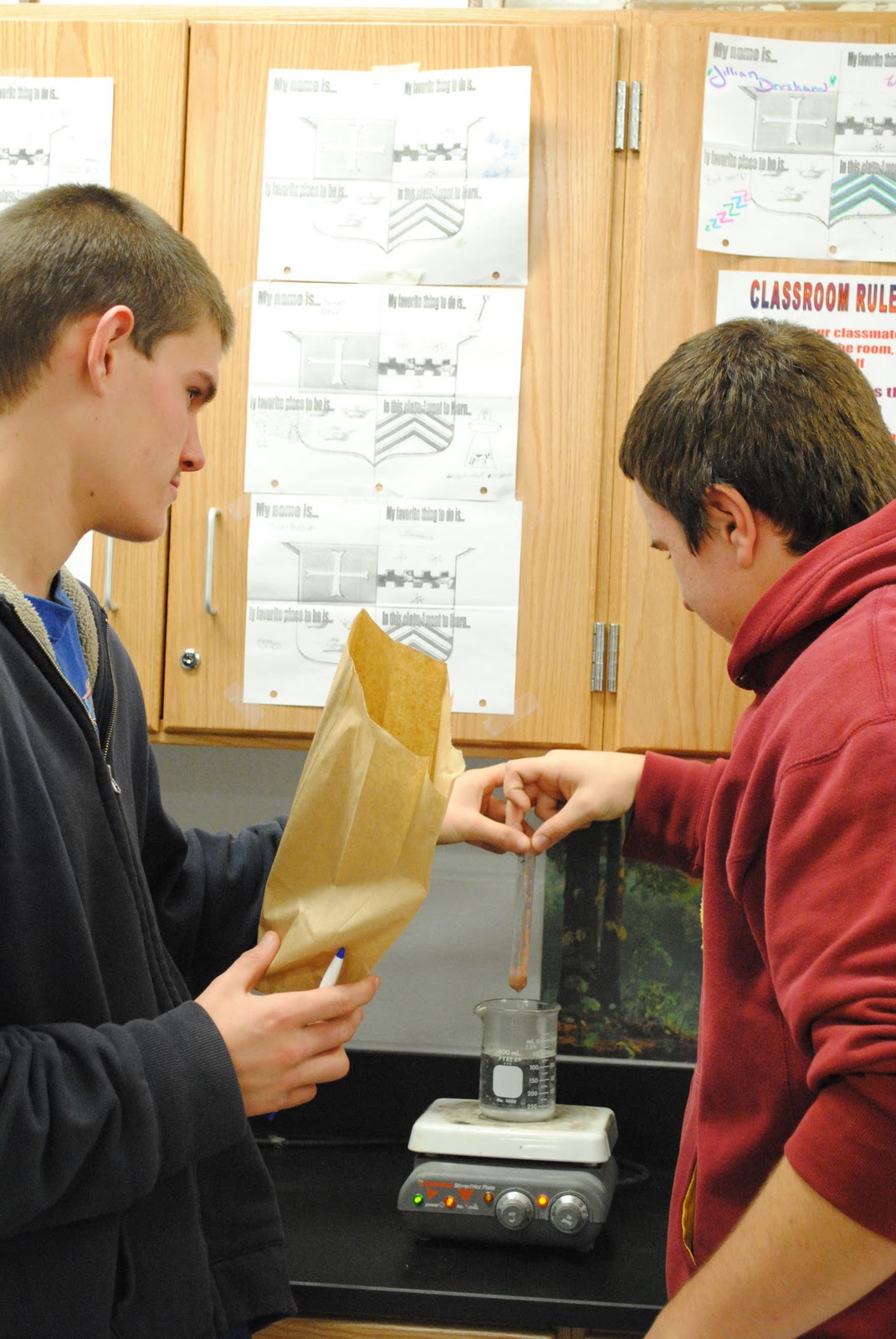
For this lab, students were called to the task of determining the last meal a murder victim ate. They were provided with the "stomach contents" of the murder victim, and performed tests to determine whether the victim had eaten protein, carbohydrates, lipids, or sugars. They then decided whether the victim last ate at Pudgie's Pizza, Gino's Italian Restaurante, or Buffalo Wild Wings, based on the tests they performed. Enjoy the pictures below!


Students working on "Tell the Tale" lab

For this lab, students were given the contents of a woman's purse found at a crime scene. The only information they were given other than the purse contents was that a hairy arm with a wedding band on was found at the top of a stairwell with two sets of bloody footprints leading away from the scene. Using the contents of the purse, students were asked to find out what the owner had done in the last week and come up with a story about what happened. Here's some students at work:

Tyniqua, Sarah, Betty

Tyler O., Cullen, Justin, and Scott
Kyle, Amber, Sam N.

Some videos of our lovely actors

Students practiced being eyewitnesses while other classmates acted out crimes. Students had to try to remember details about the people and events the next day. Here are a couple of our groups acting out their crime scene!


Tuesday, March 15, 2011

Writing Assignment

IMPORTANT: Students were assigned the writing assignment below yesterday and were given yesterday and today to work on it. It is due on Monday. Please urge your students to be working on it!

Final Pathology Assignment: RAFT
In our unit on pathology, you have learned the process a medical examiner goes through from beginning to end. To show what you have learned, you must complete a RAFT writing assignment. RAFT stands for Role, Audience, Format, Topic. This helps you focus your writing.
ROLE: You will choose one of the following crime scenes to write about. You can also choose whether you will assume the role of the pathologist or the victim!
• Scenario 1: Susan Brown was found dead, face down in an alley and had appeared to be severely beaten and strangled.
• Scenario 2: John Stemson was found in his home, sitting on his couch, with several stab wounds, including a fatal one to his carotid artery
• Scenario 3: Bobby Wright, a bank teller, was shot in the chest and killed during a robbery gone bad
AUDIENCE: A student who has not taken forensic science class
FORMAT: Descriptive essay
TOPIC: The process of a death investigation from start to finish
In your paper, you must include the following:
• A description of what the pathologist would do at the death scene
• How time of death would be determined using the stages of decomposition and potassium in eye fluid
• What the manner, cause, and mechanism of death are and how you knew that
• What type of WOUNDS you expect to see based on the cause of death
• A description of the external examination—what are some things you should be looking for and why?
• A description from start to finish of the internal examination, starting with the Y-incision and ending with sewing the body back up.
• Tests you would do on the stomach contents and what information that would provide you
• A description of what biological samples would be taken from the body and the proper way for handling and packaging these samples.
Requirements:
• Your paper should be at least 8 substantial paragraphs supported with details from your notes, the autopsy reading, the videos we have watched, and the case studies you have worked on.
• This can be typed or handwritten, but should be neat
• Grammar, punctuation, and spelling are important
• You should use language a classmate would understand while still using forensics vocabulary
• DO NOT copy directly from your notes or readings—you will receive a ZERO. You must put everything in your own words

Updates

In this class, we've discussed how CSI type shows are different from real forensics and how the "CSI Effect" is raising jurors' expectations about what is presented in court. We've also talked about the history of forensics and some famous people involved in the development of forensics. Students created timelines of 12 important events. We then delved into the different units of a crime lab and what their functions are. After that, we discussed the four federal crime labs and the NYS Police crime lab and compared the labs to each other. We then moved on to talk about eyewitness testimony and crime scene basics. Now, we are moving on to the different fields of forensics such as pathology, anthropology, odontology, and entomology.

Assignments that should be turned in:

Parent letter Tell the Tale Lab
Anthropometry Lab
History of Forensics packet (done online)
History of Forensics Timeline
Federal/State Crime labs worksheet
Quiz 1 & Quiz 2
CSI Online: Eyewitness Basics worksheet
Test 1
Death Scenarios
Deadly Picnic Lab
Murder in a Meal Lab
Time of Death Determination Practice
Autopsy Reading Graphic Organizer

Friday, January 14, 2011

Evaluations

https://spreadsheets.google.com/viewform?hl=en&authkey=COmx-vQE&formkey=dFBmaHRTMW8wODhNa2FrUEx3N2dnQWc6MQ#gid=0

Criminals in History Project Examples

Here are some examples of the wonderful work the forensics students did on their Criminals in History project. Enjoy!

Mike Tillotson

Beth Krise

Shelby Cain

Taylor Gordon

Nicole Cecce

Jon King


WANTED posters

Wednesday, December 15, 2010

Updates

In forensics class, students have been working hard on their research projects on famous criminals in history. Students are researching their criminal, creating a Prezi based on their research, a wanted poster, then they are presenting about their criminal the week of 12/20. In the midst of working on these projects, we have explored forensic fingerprinting and document analysis. Students have learned the techniques document examiners use to investigate questioned documents. Students have learned all the different classes of fingerprints as well as ridge characteristics to look for when comparing a suspect fingerprint to one found at a crime scene. Students have classified their own fingerprints, and now will be doing a lab this week in which they will uncover hidden (latent) fingerprints using a variety of techniques: dusting, magnetic dusting, ninhydrin fuming, super glue fuming, and iodine fuming. Students will develop fingerprints from many surfaces--even paper!

Wednesday, November 24, 2010

Field Trip to RMSC

Our field trip was a success! The students really enjoyed the Rochester Museum and Science Center. We even had time to explore other exhibits after our CSI exhibit. Enjoy the pictures below!


Briefing before the crime scenes

Crime Scene #2

Crime Scene #1

Louis 
Howard
Teresa
Xavier and Olivia

Beth, Tarin, Logan, Howard looking at autopsy results


The group outside of the museum

Monday, November 22, 2010

Murder and a Meal Lab

Today, students were called to the task of determining the last meal a murder victim ate. They were provided with the "stomach contents" of the murder victim, and performed tests to determine whether the victim had eaten protein, carbohydrates, lipids, or sugars. They then decided whether the victim last ate at Pudgie's Pizza, Gino's Italian Restaurante, or Buffalo Wild Wings, based on the tests they performed. Enjoy the pictures below!
All the materials: The "stomach contents" in the beakers, Iodine Reagent (for starch test), Biuret Reagent (for protein test), Benedict's Solution (for glucose test), and brown paper bags (for lipid test)
 Mike, a little grossed out by the smell of the "vomit!"
Jenna adding Biuret reagent to test for proteins

Beth and Justin performing protein test

 Dylan and Bryan putting their test tube in the hot bath
 Test tubes in the hot bath to see the vomit reacts with Benedict's solution, which would show the presence of glucose
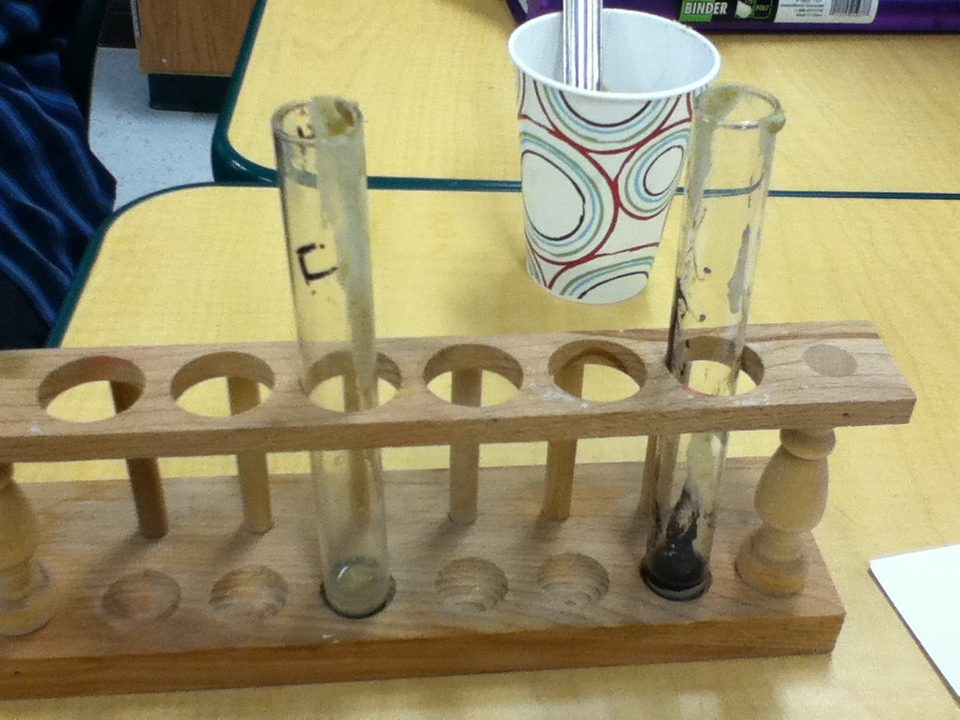
All the test results from left to right: Negative test for protein, negative test for glucose, positive test for starch, and positive test for lipids (stain left on brown bag)

Field Trip Tomorrow, 11/23!

Tomorrow, our forensic science classes will be traveling to the Rochester Museum and Science Center for a CSI: The Experience Exhibit. To preview the exhibit and the crimes we will be solving, click the link below!
http://www.csitheexperience.org/about_preview.html

For forensics activities related to this exhibit to try with your family, go here:
http://forensics.rice.edu/html/famguide.html

Friday, November 12, 2010

Updates 11/12


Hello everyone,
Recently in Forensics, we've been learning about BLOOD. We discussed blood spatter analysis, and did a lab where the students experimented with how height, angle, speed, and target surface affects blood spatter. The pictures below show some students doing their experiments.

Katie and Sharon testing different weapon transfer patterns and how it compared to the stain found on a cloth at the scene of the crime


Brittani testing the effect of different surfaces on blood spatter
Dave, Rodney, and Shayne testing how angle of impact influences blood spatter
Theron and Dylan testing angle of impact

Daryl, Taylor, and Hannah testing the effect of height on blood spatter


Donald, Harley, and Anthony analyzing the difference between high velocity impact spatter and medium velocity impact spatter

Saturday, October 30, 2010

Updates 10/31


Hello everyone,
We have been doing a lot of interesting things in forensics class. We have discussed the details of properly handling and processing a crime scene, chain of custody, the importance of search warrants, and how incorrect handling of evidence can lead to many problems in a court case. We have explored the 1892 Lizzie Borden case, where a 30 year old woman is accused of murdering her mother and father with an axe. On monday, students will present their verdicts to the class as to whether they think Lizzie was guilty or innocent. We have also explored the physical evidence present in the ever-famous O.J. Simpson case. Friday, we did a lab experiment involving removing fuzzies and hairs off a piece of clothing and looking at it under a microscope. Students compared animal and human hair, as well as different types of fibers.
In addition to these things, students learned how to properly sketch and photograph crime scenes. I set up a mock crime scene and students had to correctly photograph and sketch the scene. This was a lot of fun!!
Crime scene in room 234!
Blood Pool on newspaper by Ms. Sosnoski's Desk and trail of blood leading to the weapon
Bloody Handprint on Telephone
Hammer, Blood Pool 2, and Bloody Footprints leading out the door

Broken window and blood
On November 23rd, we will be heading to the Rochester Museum and Science Center to take part in the CSI: The Experience Exhibit. To view information about the exhibit, click the link below:

CSI: The Experience

Monday, September 13, 2010

What's going on in Forensics so far?

Well, next week begins the third week of school, and for both Astronomy and Forensics, we're just getting into the good stuff!


In this class, we've discussed how CSI type shows are different from real forensics and how the "CSI Effect" is raising jurors' expectations about what is presented in court. We've also talked about the history of forensics and some famous people involved in the development of forensics. Students created timelines of 12 important events. We then delved into the different units of a crime lab and what their functions are. After that, we discussed the four federal crime labs and the NYS Police crime lab and compared the labs to each other. At the end of last week, we began to talk about the basics of eyewitness testimony. Next week we will be moving on to the different fields of forensics such as pathology, anthropology, odontology, and entomology.

Assignments that should be turned in:

  • Parent letter & all other introductory material
  • Courtroom Vocab Crossword
  • Tell the Tale Lab
  • Chapter 1 HW 1 Worksheet
  • Anthropometry Lab
  • History of Forensics packet (done online)
  • History of Forensics Timeline
  • Federal/State Crime labs worksheet
  • CHapter 1 HW 2 Worksheet
  • Quiz 1
  • CSI Online: Eyewitness Basics worksheet
  • Warm up sheets & daily CSI challenges for week 2 and 3